CALL 911 OR GO TO THE ER IF YOU SEE ANY OF THESE
- Sudden onset — wall-holding appeared in hours or days, not gradually
- Accompanied by dizziness, spinning sensation, or nausea
- One-sided weakness, facial drooping, or slurred speech alongside the unsteadiness
- Severe headache with the balance change
- Confusion or disorientation that is new
- A fall with head impact, loss of consciousness, or inability to get up
Eight things to write down before you call
Check each item as you note it. The more detail you can provide, the more useful the call will be.
- When it started
Approximately when did you first notice Dad reaching for walls or surfaces while walking?
- What he grabs
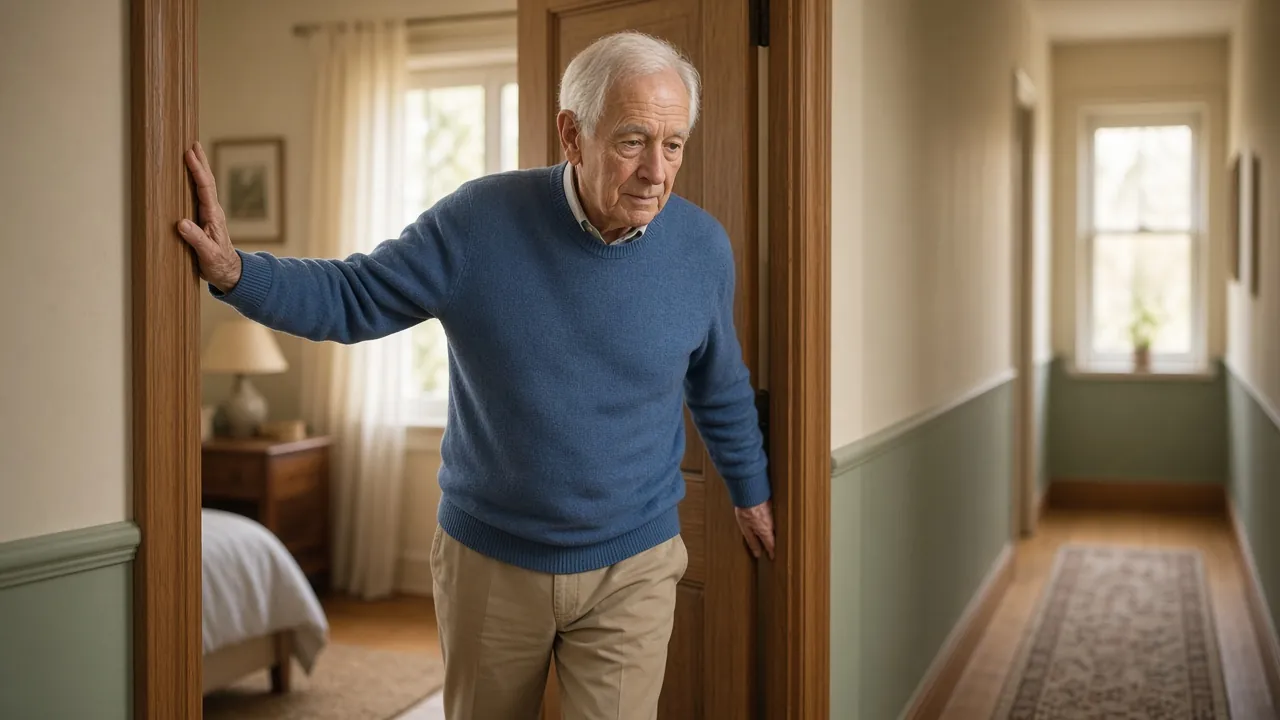
Walls, countertops, chair backs, doorframes? Does he reach proactively or only when unsteady mid-step?
- Which rooms or routes
Does it happen everywhere, or mainly in specific places?
- Time of day
Is it worse in the morning, after sitting, or at night?
- Recent changes
New medications, recent illness, a fall, changes in sleep or activity in the past 4 weeks?
- His awareness of it
Does he mention feeling dizzy or unsteady? Or does he seem unaware he is doing it?
- Any near-falls or falls
Any stumbles, grabs to avoid falling, or actual falls — even minor ones?
- Full medication list
All prescription drugs, over-the-counter medications, supplements, and vitamins with doses.
Example notes
- Started about 3 weeks ago, maybe after his last medication change.
- Mostly the kitchen counter and the hallway wall. Reaches out before he starts moving.
- Mainly the hallway to the bathroom at night. Fine in the living room during the day.
- Worst right after he gets up in the morning and again after dinner.
- Started a new blood pressure medication about a month ago.
- He says he feels 'a little wobbly' but doesn't think it's a big deal.
- Grabbed the doorframe last Tuesday and said 'whoa.' No fall but it scared him.
- Lisinopril 10mg, Metoprolol 25mg, Melatonin 5mg, fish oil.
What the doctor is looking for
Wall-holding is a symptom, not a diagnosis. The doctor will use your observations to narrow down the most likely cause. The most common causes in older adults include vestibular dysfunction (inner ear balance problems), orthostatic hypotension (blood pressure dropping on standing), medication side effects (especially blood pressure drugs, sleep aids, and antihistamines), peripheral neuropathy (reduced sensation in the feet), and early Parkinson's disease or normal pressure hydrocephalus.
The detail that often matters most is the medication list. Many older adults are on combinations of drugs that individually have modest balance effects but together create significant impairment. Bringing a complete, current medication list — including over-the-counter drugs, supplements, and vitamins — is one of the highest-value things you can do before the appointment.
The second most useful detail is timing. Is it worse in the morning (suggests orthostatic hypotension or medication timing)? After sitting (suggests deconditioning or circulatory issues)? At night (suggests lighting and vision)? In specific rooms (suggests floor surface or distance between support surfaces)? Each pattern points toward a different cause.
Sample call script
Copy this script and fill in the brackets before you call. The nurse triage line will ask most of these questions anyway — having the answers ready shortens the call and improves the outcome.
Hi, I'm calling about my father [Name], DOB [Date]. I've noticed he's been holding the wall and touching furniture to steady himself when he walks. It started about [timeframe] ago. It happens mainly [location/route], and seems worse [time of day]. He [is/is not] aware of it and [has/has not] mentioned feeling dizzy or unsteady. There [have/have not] been any near-falls or falls. He is currently taking [medications]. I wanted to flag it before it becomes a fall. Can the doctor see him, or is there a nurse I can speak with?
You have your observations. The next step is to call the doctor's office, share what you wrote down, and ask for guidance on whether an appointment is needed. If you are not sure what to say, use the sample script at the top of this page.